

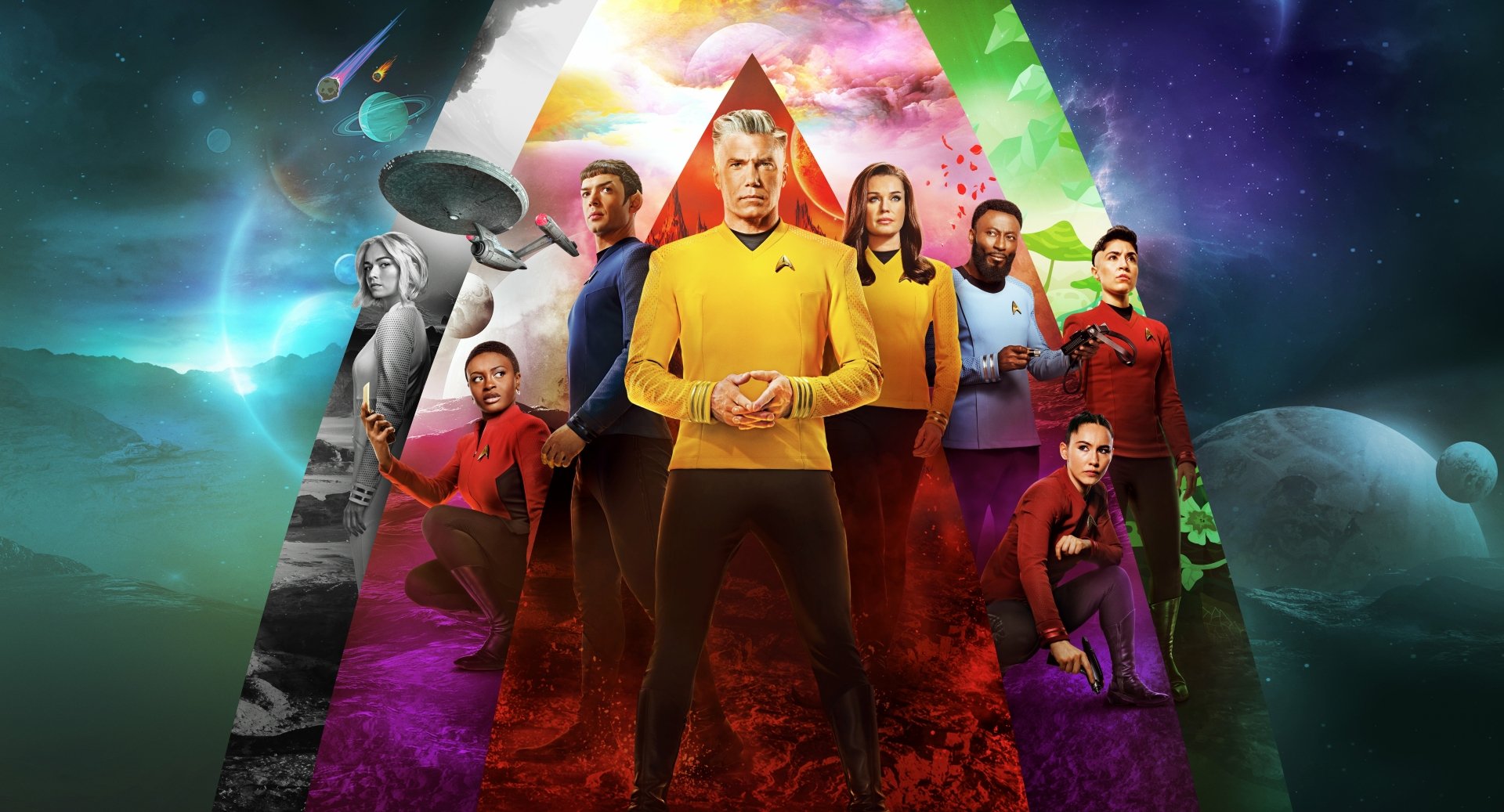
The purchase of Paramount by Skydance Media, or by a tech mogul’s nepo baby, depending on your point of view, might mean Star Trek ends its current ‘era’ of production. I’m going to go on to give my view of this era, but it’s probably safe to say that, at this point, it has sent the franchise into decline rather than maintaining or growing the previous pop culture-defining eras.
This might be long; it’s been something I’ve been thinking about for a while.
There was some good stuff
I’m not someone who stood on the sidelines and made a fortune grinding out criticism of modern Star Trek. The truth is, I’ve watched most of it and stayed silent on the issue beyond the thoughts in my own head. I also lived through the ‘this is not Star Trek’ era that got pretty vicious around the launch of Deep Space Nine. I faced it full-on at conventions, where even Deep Space Nine cast members caught flak. I have the scars from merely witnessing the vitriol.
Despite thinking this era was significantly weaker than previous eras, there was some good stuff.
- Picard season three is a work of art. The first half is a masterclass in writing a serialised Star Trek show and in changing legacy characters, while the second half is also very good.
- I maintain that Discovery season two is an excellent adaptation of the Star Trek movie, delivered in a serialised TV format.
- Lower Decks was interesting, but I tend to think once a franchise delivers a show like it, the first nail in the coffin has been hammered in.
- Strange New Worlds continues to be a production with everything going for it, except the writing staff seems to be writing a Buffy show in Star Trek trappings.
Beyond that, things didn’t really work or became absolutely dire. I tried to watch Star Trek: Starfleet Academy, but I couldn’t get through it, as it basically became the poster child for everything I’m about to run through in this post. The only good thing you could say about Star Trek: Starfleet Academy was that it didn’t step into malicious wrecking territory like The Acolyte.
Star Trek was always woke!
A science fiction TV show, specifically one like Star Trek, should be about exploring ideas, should favour prompting people to think rather than engaging in cultural lecturing.
The phrase “Star Trek was always woke” is often used as a rebuttal to poorly articulated criticisms of the current-era Star Trek. These types of snappy phrases are a modern online tactic. I am pretty sure people reading this post can think of one or two others. Why? They are a semantic trap designed to close down the argument rather than engage with its details.
This is because ‘woke’ has two meanings in the statement. It’s a Motte-and-Bailey tactic.
- The Motte: ‘Woke’ means being aware of social injustice and advocating for a diverse, progressive future. Under this definition, Star Trek has always been ‘woke’. This has the strength that few good-faith actors would argue with the concept.
- The Bailey: ‘Woke’ refers to a specific modern-era style characterised by identity-first characterisation, the verbalising of subtext, the denigration of allegory and the use of contemporary shorthand that drifts into lecturing.
The trap works because people are often critical of the Bailey, this post, for example. The trap is spun when someone, instead of engaging with that argument, just retreats back to the Motte, spouting that this has always been the case. They often quickly follow it up with a look at the interracial kiss! Yes, but they just did the inter-racial kiss; they didn’t talk about it, verbalise it or moralise about it on screen.
It just happened, and it wasn’t a lecture, which is exactly the argument people are making in the Bailey.
So, what are the arguments in the Bailey? Well, I’m not saying people have argued them well, and they often get wrapped up in politics I despise, which doesn’t help either. After cracking my head against it while relaxing in the Peak District, these are the key differences present in the Secret Hideout era of Star Trek:-
- Ideas being replaced by politics
- Discovery being replaced by affirmation
- Relevancy being replaced by being topical
- Archetypes being replaced by stereotypes
- Moral complexity being replaced by moral clarity
Each of these allows the statement “Star Trek has always been woke” to remain true, but one results in stronger writing that prompts the audience to think, while the other just tells the audience what to think. It shifts the writing from aiming to lead on cultural topics to lecturing on them.
Ad Astra per Aspera
One of my favourite episodes of Star Trek in the Secret Hideout era is Ad Astra per Aspera from Strange New Worlds. It’s one of the closest episodes of modern Star Trek to what we saw in previous eras. It’s about how Number One, the first officer of the Enterprise, is a genetically altered species, which is against Federation law. As a result, a legal case ensues as to whether she falsified her enlistment records.
The episode is one of the better modern Secret Hideout Star Trek episodes because it leans toward outcomes that lead to better writing.
Ideas versus politics: It largely keeps itself to the idea rather than the politics through conflict between institutional safety and individual liberty. The Federation bans genetic augmentation because of past catastrophes, but the law, when applied to individual circumstances, can be catastrophic.
Relevance versus topical: It goes some way to enduring relevance rather than passing topicality by focusing on the struggle of a person hiding an essential part of themselves. That essential part of themselves uses the allegory of genetic modification, linked to Star Trek’s history through the war crimes of Khan Noonien Singh. It’s easy to transpose that timeless struggle to being gay, or a migrant, etc. It will remain timeless as other struggles unfold.
Discovery versus affirmation: At least in the first two acts of the episode, we are in a process of discovery, not affirmation. The Federation charter, the prosecutors’ valid fears, and trying to forge a legal thread forward. We are discovering history, the arguments and the concerns and the audience is very much being given the material to think through the argument for themselves. It’s a bit full-on affirmation towards the end, but it survives because of the strength of the first two acts. Star Trek has always indicated what it thinks is the right answer, but at its best, it’s done the work to that stance.
Archetypes versus stereotypes: The person facing the struggle is Una, Number One; she’s a pretty major character (who, in my view, should get more screen time). In the context of the episode, she is positioned as an archetype, not a stereotype: The Stoic Officer. She is in a battle between her duty and a personal truth. This is an enduring archetype and a problem people face across numerous real-world examples, yet it avoids becoming very specifically topical.
Moral complexity versus moral clarity: In my view, Ad Astra per Aspera’s strongest element lies in its navigation of moral complexity rather than moral clarity. The episode acknowledges that the Federation is not perfect. Like any institution, their aspirations are held back by past pain and by a desire not to repeat historic problems. It does this without denigrating the Federation or refashioning it as a villainous institution (another thing people often rewrite).
This is why Ad Astra per Aspera is one of the best modern Star Trek episodes: it is materially different from many other episodes. It’s not perfect, as if we compare it to “The Measure of a Man,” a Star Trek: The Next Generation episode that also argues an idea and a legal point.
The differences that weaken Ad Astra per Aspera slightly are: –
- The Next Generation episode has a closing argument based on the consequences of the judgment (a move to slavery) under a universal principle, which is a stronger idea than on the politics of civil rights and on asking the Federation to live up to very 21st-century, coded social norms.
- The Next Generation presents a philosophical lesson that tends to lean toward leaving people something to think about. Strange New World’s episode leans a bit more toward legal judgment on 2024 social issues.
- The Next Generation episode leaves the question open, suggesting the viewer’s thinking and personal discovery are not yet closed, while Strange New Worlds considers the argument closed.
- The Next Generation episode utilises the idea of a misguided peer, in the form of a scientist who views Data as an object. Strange New Worlds leans a bit more into the idea that people are moral adversaries.
I tend to think The Measure of a Man leaves you with thoughts about how fragile the rights we assume we’re guaranteed are. Ad Astra per Aspera is very good in many respects, as I’ve outlined, but still falls a bit short in the warmth of its conclusion, leaving us with a sense of having done right.
A few wonderful trends
While the forced dichotomies outlined so far account for many of the challenges in the current era of Star Trek, which have weakened the franchise significantly. A few other trends come into play. It may even be that some of these trends are the reason behind the writing choices manifesting in the scripts.
Allegory is cowardice
The idea that allegory isn’t good enough or is a form of cowardice was an argument I posted about a while back, which indicates I learned that people think like this from this article. It’s interesting that the source no longer exists.
The literal idea that any medium that uses allegory to explore an idea is a weakness because it gives the viewer a ‘get out of jail’ card. The idea of the small glass hammer tapping the audience’s temple with the abstracted, reshaped idea, inspiring them to think, isn’t enough; you need to create a massive sledgehammer wrapped in the message that you can literally beat the audience’s brainpan to a pulp with.
The weakness in this argument is that people just stop watching, even those who are amenable to the messaging, because they feel their intelligence is being insulted.
I think this represents a generational shift at the macro level, while I’m sure there are exceptions. It seems to be a shift from allegory to activism, from seeing things as a tool for reflection to seeing them as a literal mirror of affirmation, and the complete loss of the ability to parse things through metaphor.
Everything is therapy
It also seems the Star Trek milieu has changed materially through the lens of therapy language and a therapy environment.
Star Trek from earlier eras presented the ship as safe, to the point that it was often a character in and of itself. The crew was professional, and the environment was obviously professional. This reached its height in Star Trek: The Next Generation, with the ship coming across as a nice, plush office. It was the ideas that were meant to be challenging, and the ship was the environment, like a great University, in which they were challenged and explored.
In the current era of Star Trek, the ideas seem safe and affirming. Like being challenged by them is the danger. Instead, the audience is constantly presented with an environment which seems like a psychological cluster-fuck, people crying, fighting and moving from trauma to trauma. Is this surprising with the generational change to everything being trauma, and life being seen through the lens of an unfolding therapy session, with a focus on being protected from ideas?
The only advantage here is that some of the best Strange New Worlds episodes focus on individuals dealing with trauma, such as Under the Cloak of War.
Writing about TV shows
The writers of Star Trek of yesteryear were an interesting cornucopia of people with all sorts of backgrounds and involvement in different media. They had experience. There is some argument today that the people writing for our franchises originate from an educational track in media and writing, and that is pretty much their reference point.
This creates TV shows and franchises that are like a grand Ouroboros, essentially eating themselves. It’s media about media and franchises being about themselves. While the history and lore of a franchise can and should be a source of stories, there is a way to do it well and a way that just consumes the creative endeavour itself. Star Wars really suffers from this problem, while Lower Decks is sort of built on the whole premise, creating an Ouroboros based on humour.
This trend also manifests at the macro level outside the franchise itself, and it is most evident in Strange New Worlds. Strange New Worlds doesn’t even feel like a Star Trek show, most of the time. It has a fantastic cast, amazing production values and is one of the most gorgeous-looking Star Trek shows ever put to TV, but in its structure and scripts, it’s more like Buffy: The Vampire Slayer, but with technology replacing the magical and mystical.
The Gorn are presented more like a Buffy series big bad than representing an idea to wrestle with. The crew of the ship act more like a Scooby Gang at times than a professional ship with a command structure. The whole arc of season three and the finale is literally a Buffy-style plot wrapped in a Star Trek suit, right down to an empowered female finding a purpose in sacrificing herself to stop ‘demons’ from another dimension from destroying the universe. They’re even re-doing the Buffy and Angel gimmick episodes like knocking them off a list: the singing episode first (I realise Buffy wasn’t first), then the puppet episode next season. They’re not even trying to obfuscate it at this point.
I suspect this is because the writers who are educated on media are transferring in one of their favourite influences.
The rise of didactisism
I guess after all these words, the big question is: when did our media get a remit to go hard on a didactic approach? Someone better than me can probably pin down the timeline and pathology of when this happens, but that is the major shift. We have to instruct people about what to think and what are good thoughts. Any sense of taking a dialectical approach, focused on allowing people to reach conclusions themselves by presenting ideas, came to be viewed as imperfect, as it offers the opportunity for people to reach not only the ‘wrong’ conclusion but also to form ‘incorrect’ ideas and ‘opinions’ around the ‘right’ one.
I’m willing to admit I have quite a strong reaction to didactic approaches, so this transformation is going to hit me harder than most. I also get, for some people, and I sense this is generational sometimes, a more dialectical approach. People just want to see their experience mirrored in the show.
You’ll never persuade me it’s the better approach, or that it results in better-written TV.
…And, finally
There you have it: my view on why the modern era of Secret Hideout’s Star Trek is materially worse and not as well written as previous incarnations of the show. I’m not mourning the end of this era because I’ll miss what was produced, but more because we can’t guarantee that what will happen next will necessarily be better.
I get that modern Star Trek exists in a totally different era and faces the challenges of serialised TV, streaming, shorter seasons that make episodic formats more challenging, a different on-ramp for writers, which tends to be more a background in film and TV rather than wider reading and life experience and our politics surround is also very different. I accept that not all previous-era Star Trek episodes were fantastic, but many were! I just think the approach of yesteryear was more robust and better founded.
I got some stuff I enjoyed, but ultimately, the franchise was constantly chipped away at to the point it might have died from a thousand cuts.